Environment Solution
Cold Weather Cable Tie Solutions for Winter Outdoor and Cold Storage Routes
Choose cable ties, mounting bases and stainless options for winter rooftops, refrigerated warehouses, cold rooms and low-temperature industrial cable routes where ordinary ties may become stiff, crack or loosen.
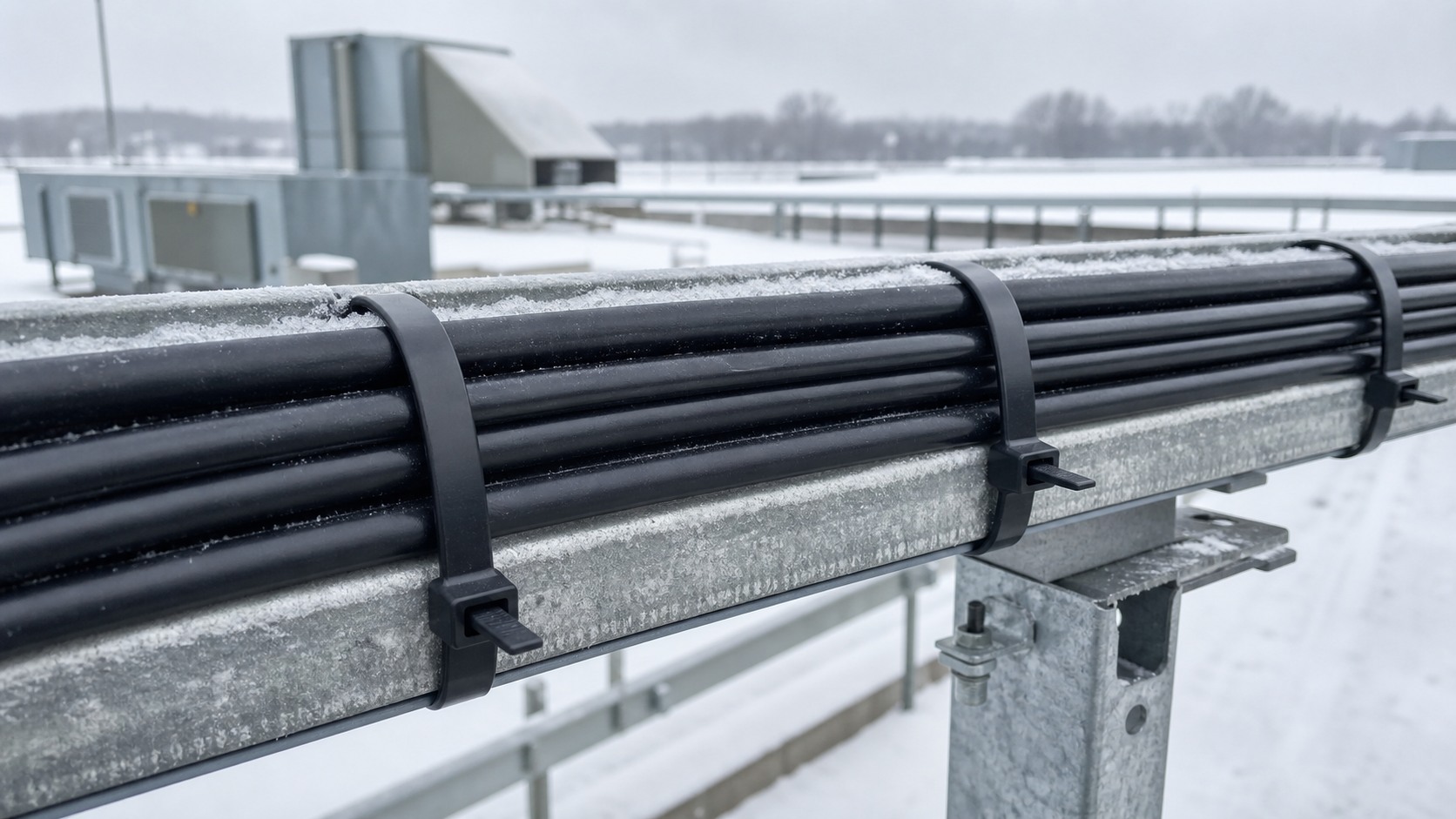
Application visual: black cold-resistant nylon ties hold cable bundles to a frosty galvanized rooftop support rail.
Environment Introduction
Cold-weather cable routes need more than normal tensile strength. Low temperature can reduce plastic flexibility, make installation harder and increase the risk of cracked heads, split tails or loose bundles after service.
The correct specification depends on where the tie works: snowy outdoor cable trays, rooftop HVAC supports, freezer warehouses, refrigerated rooms, protected cold-room cabinets or mixed routes that also face UV, moisture, vibration or corrosion.
For clean cold rooms, white or natural cold-resistant nylon ties and mounting bases help keep routing organized. For exposed winter routes, black UV/cold-resistant nylon or stainless steel may be the safer starting point.
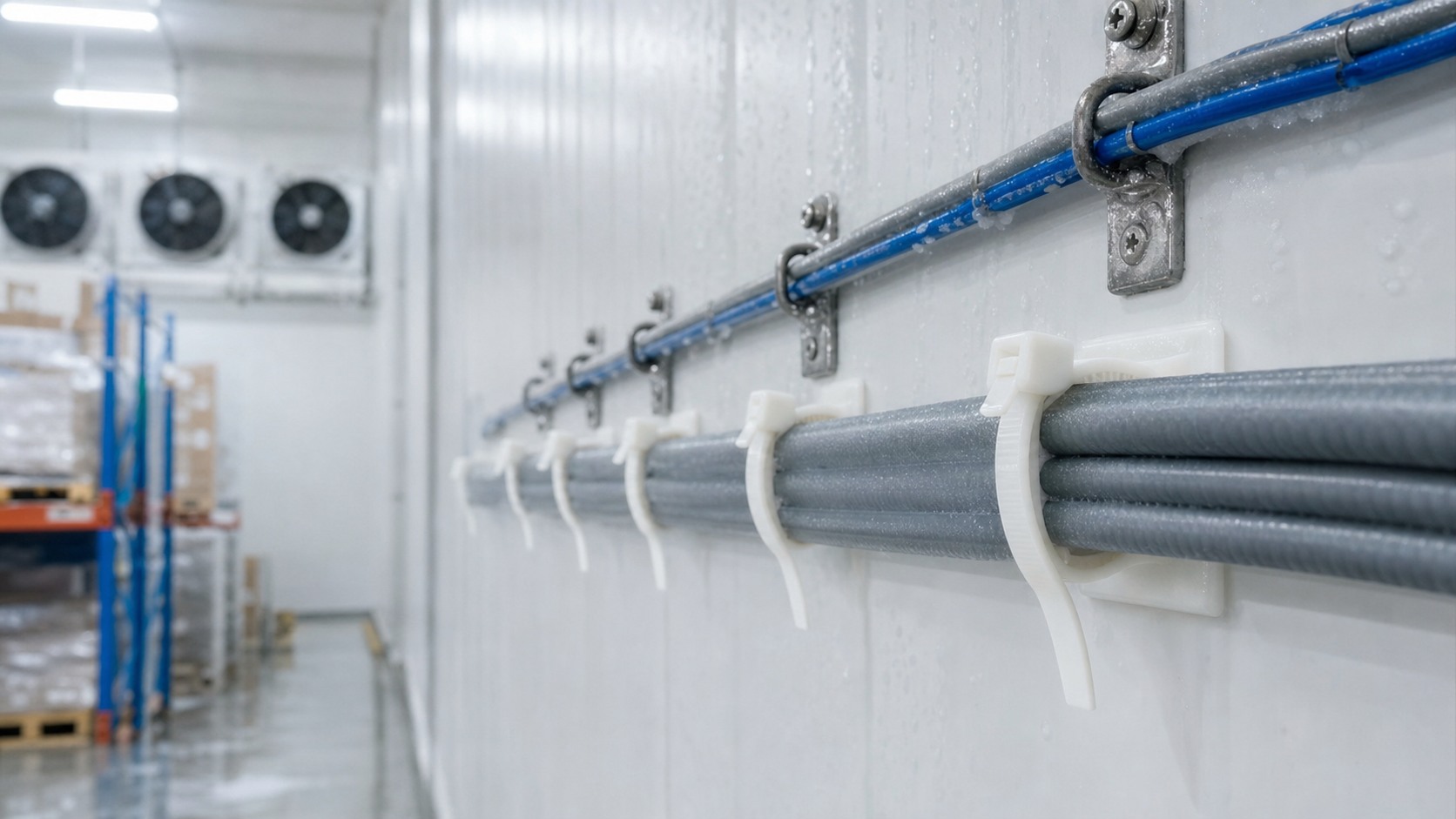
Application visual: refrigerated warehouse cable route fixed to insulated panels with cold-resistant nylon ties and mounting bases.
Cold Weather Pain Points
Brittle Tie Heads
Standard nylon ties can lose flexibility in cold weather and crack near the locking head during tightening or impact.
Loose Winter Bundles
Gloves, frost and stiff cables can lead to under-tensioned loops or tails that are not pulled fully through the head.
UV Plus Freeze-Thaw
Outdoor routes often face sunlight, snow, moisture and freeze-thaw cycles at the same time.
Inspection Difficulty
Snow, ice and low-temperature equipment areas make failures harder to detect and more costly to repair.
On-Site Problem Analysis
Before choosing the part number, separate the route by exposure and handling risk. A tie that works inside a protected freezer cabinet may not survive the same service life on a snowy rooftop tray.
Check whether the tie only bundles cables or also secures the bundle to a real support point. In outdoor winter routes, the loop should hold the cable bundle to the tray, rail, mounting base or frame where support is required.
Inspection rule: reject any installed tie with a cracked head, split tail, incomplete loop, floating support, sharp cut end or tail that does not exit the locking head correctly.
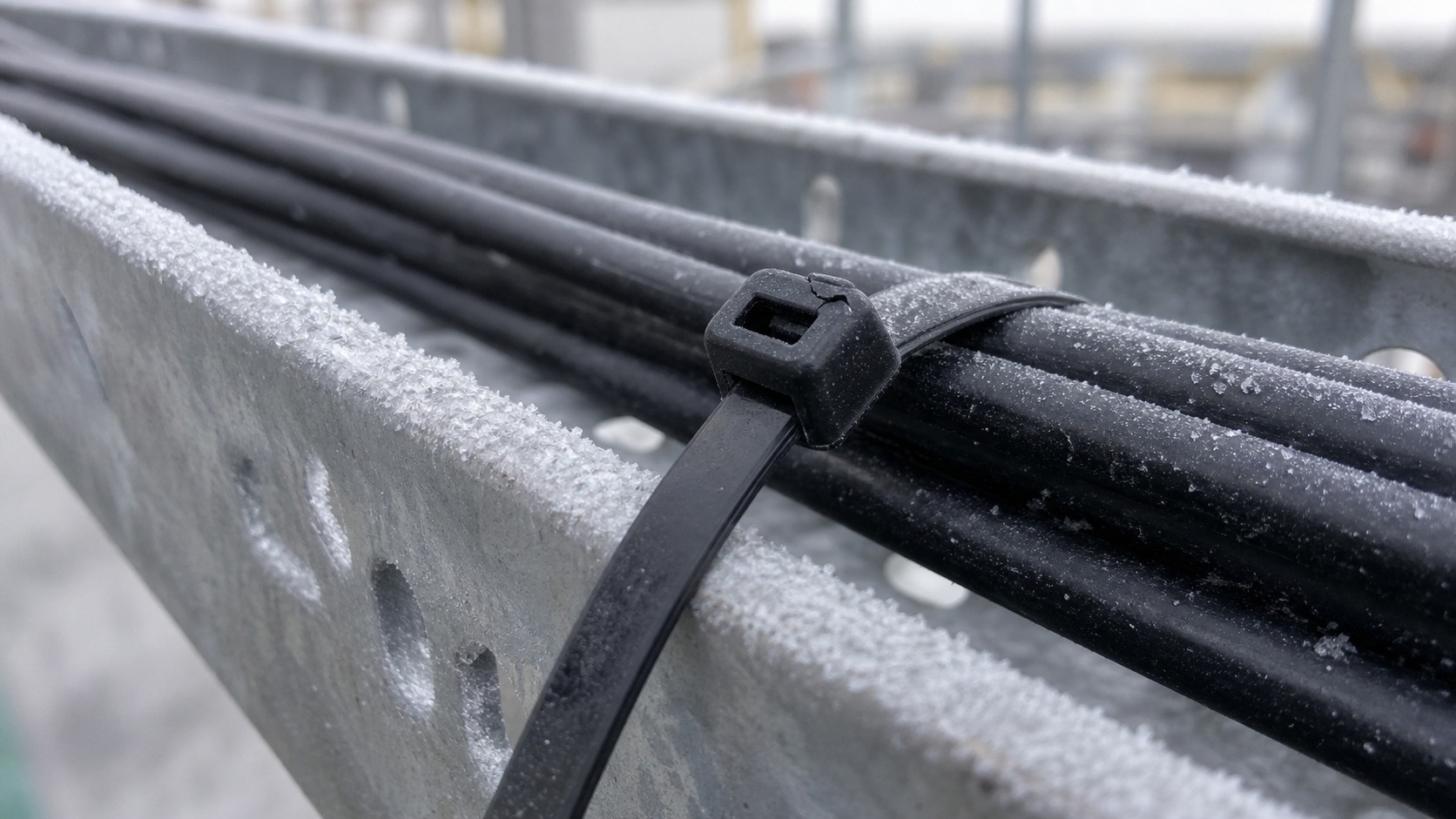
Problem visual: cold and frost can expose weak tie heads and loosen cable retention over time.
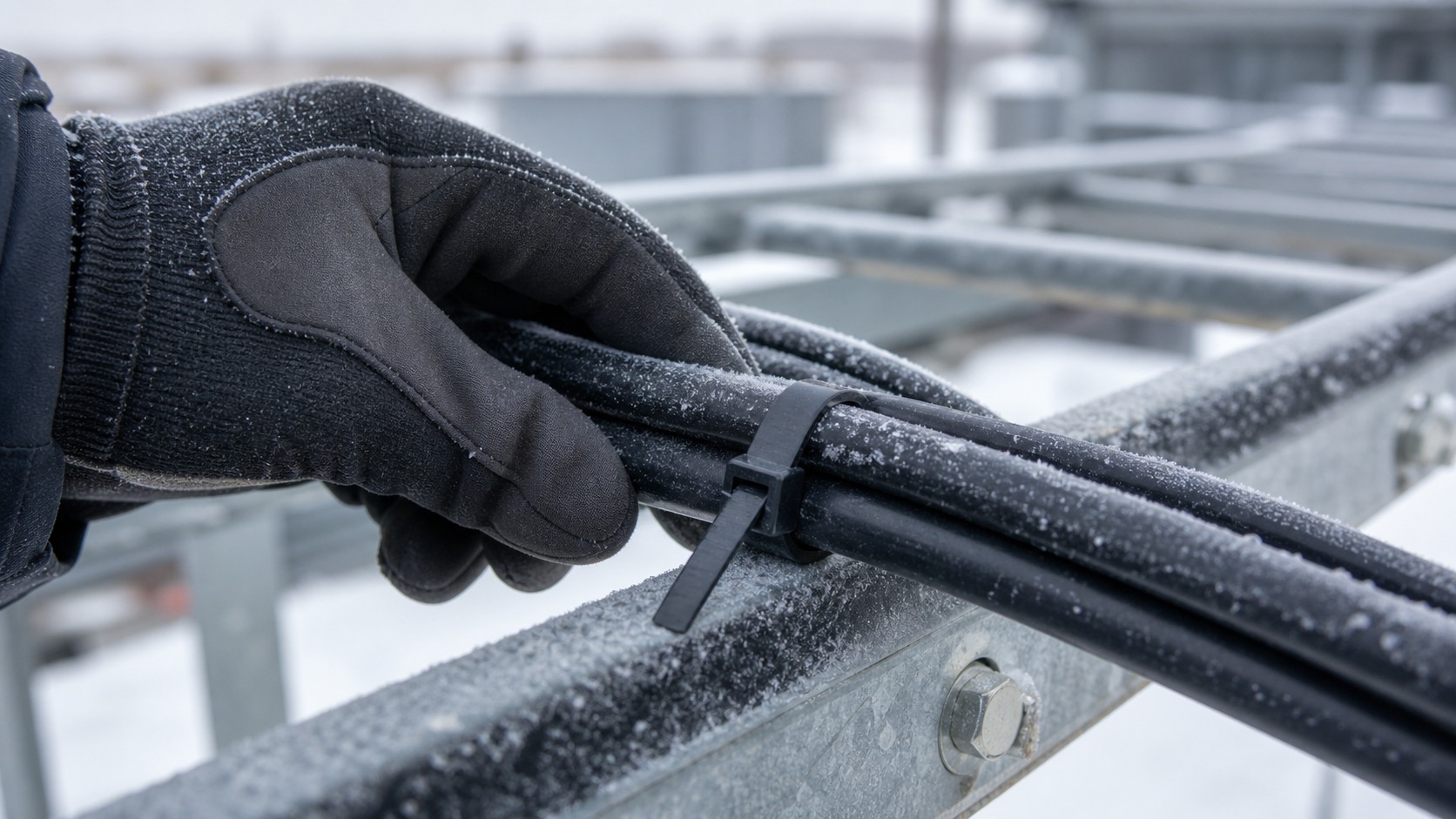
Inspection visual: gloved maintenance work must leave the locking head, tail exit and support loop visible.
Recommended Solution
Start with low-temperature toughness, then add the real exposure conditions: UV, moisture, vibration, corrosion, chemical contact, impact risk and inspection interval.
For cold storage, use cold-resistant nylon ties and stable mounting bases on insulated panels or equipment frames. For winter outdoor cable trays, use black UV/cold-resistant nylon ties. For severe exposed support points, stainless steel ties can provide stronger retention where plastic aging risk is unacceptable.
Cold Room
Cold-resistant nylon ties with panel-safe mounting bases for clean, organized routing.
Outdoor Winter
Black UV/cold-resistant nylon ties for snow, frost and sunlight exposure.
Severe Support
Stainless steel ties for high mechanical risk, long service intervals or mixed corrosion exposure.
Route Selection Workflow
- Confirm working temperature and installation temperature; they are not always the same.
- Classify the route: outdoor winter tray, rooftop equipment, cold storage room, freezer warehouse or protected cabinet.
- Identify UV, moisture, freeze-thaw, vibration, chemical or corrosion exposure.
- Check the actual support: rail, tray rung, mounting base, insulated panel, post or equipment frame.
- Select tie material, width, length, tensile strength and mounting method according to the route zone.
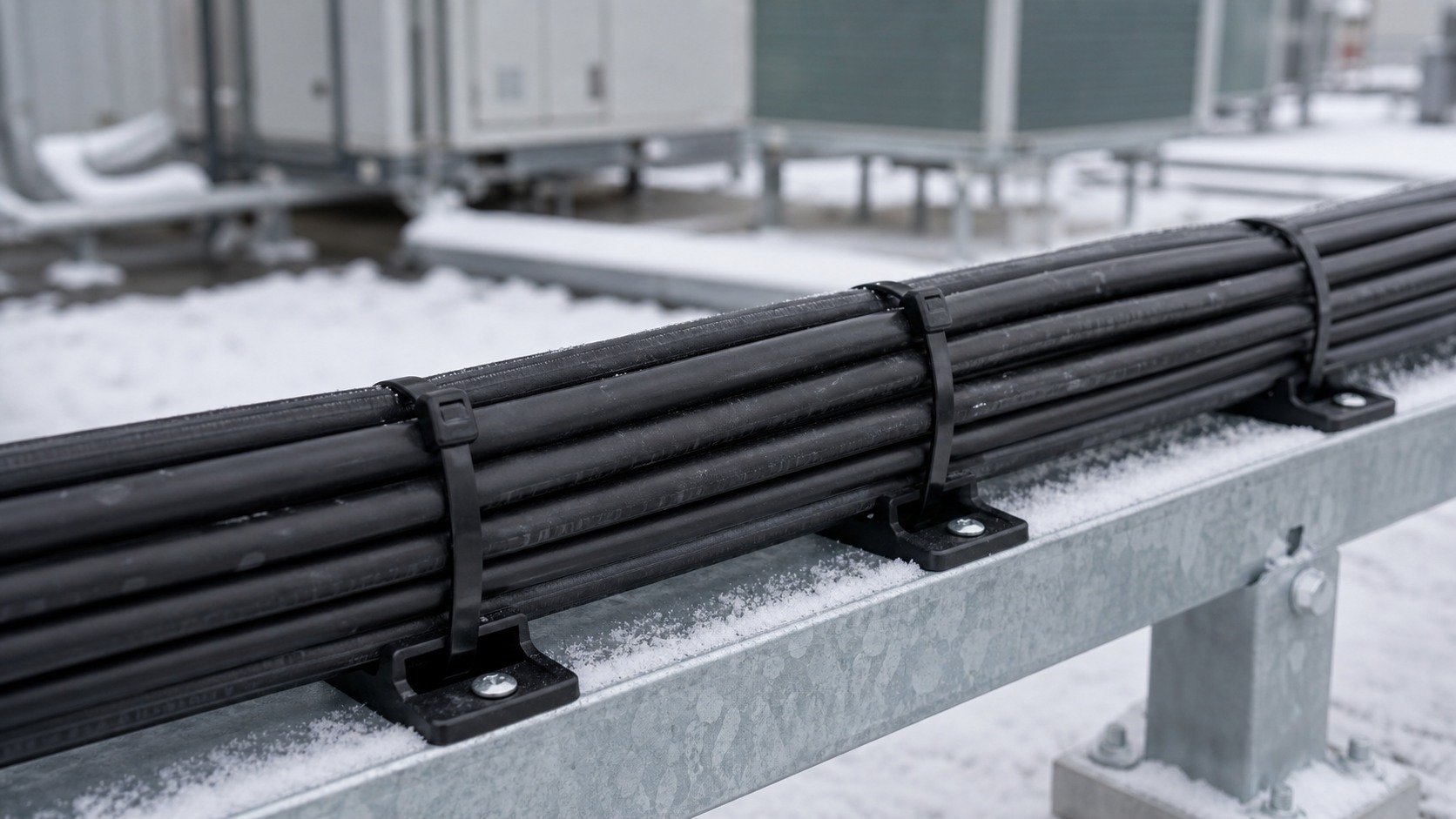
Solution visual: screw-mount bases help keep cold-weather cable bundles fixed to a known support path.
Product Combination
A cold-weather project usually needs a mixed product schedule. Product photos help identify material and geometry; application images should still show the real route and support relationship.
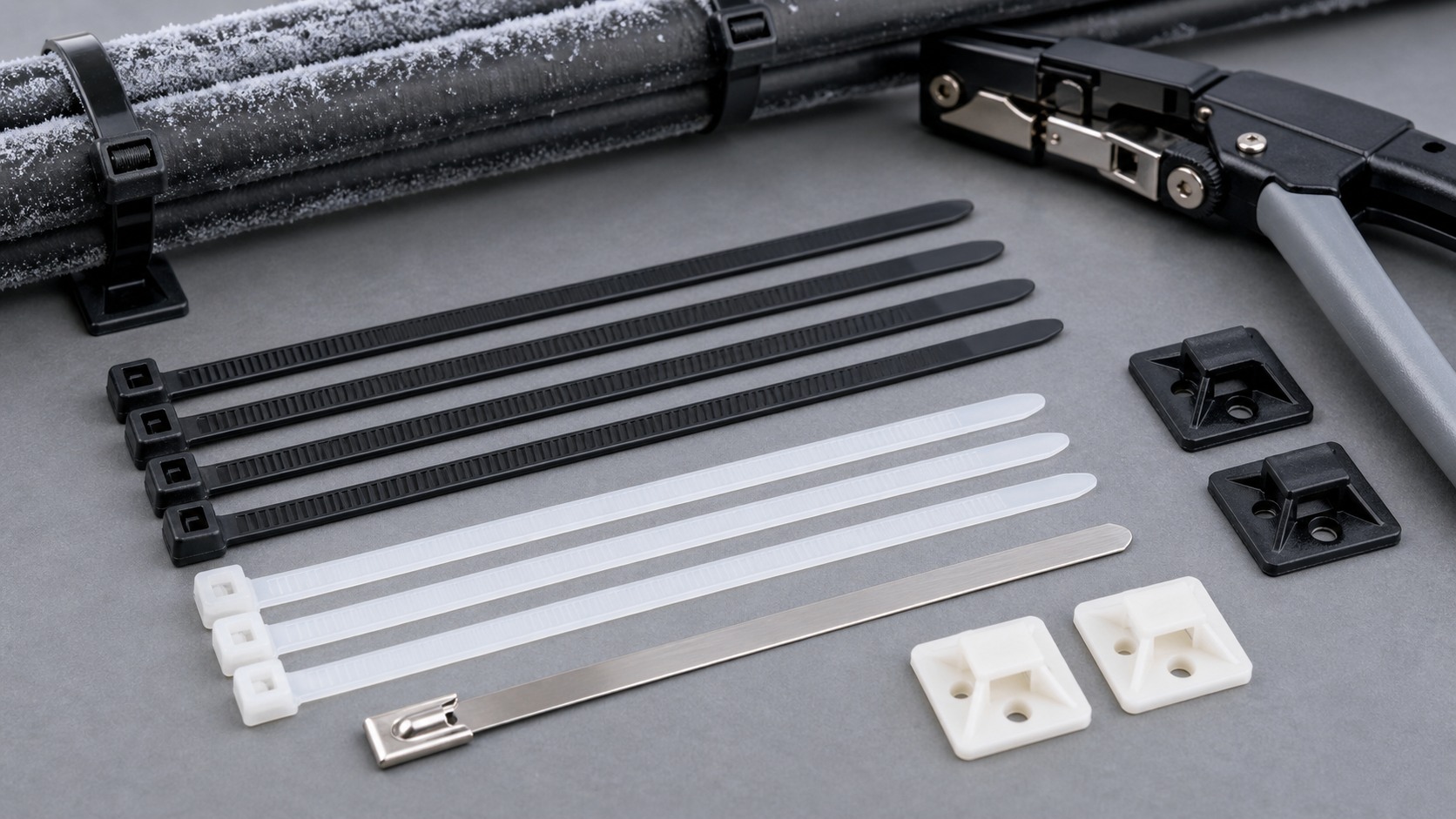
Product visual: black UV/cold nylon ties, natural nylon ties, stainless tie, mounting bases and a tension tool for material selection.
Black UV/Cold Nylon Ties
For outdoor winter cable routes, rooftop equipment, telecom support rails and exposed galvanized trays.
Natural Cold-Resistant Ties
For clean cold rooms, refrigerated warehouses, protected panels and identification-friendly indoor routing.
Stainless Steel Ties
For severe exposed supports, long inspection intervals, wet routes, high mechanical risk or mixed corrosion exposure.
Mounting Bases and Tools
For repeatable fixing points and controlled tension when installers are working with gloves or limited access.
Product Parameters
Do not judge cold-weather ties by the lowest temperature number alone. Confirm material, tensile strength, width, bend behavior, installation method and support surface before bulk installation.
For critical routes, request samples and test the tie at the actual installation temperature with the same cable diameter, support and tool that will be used on site.
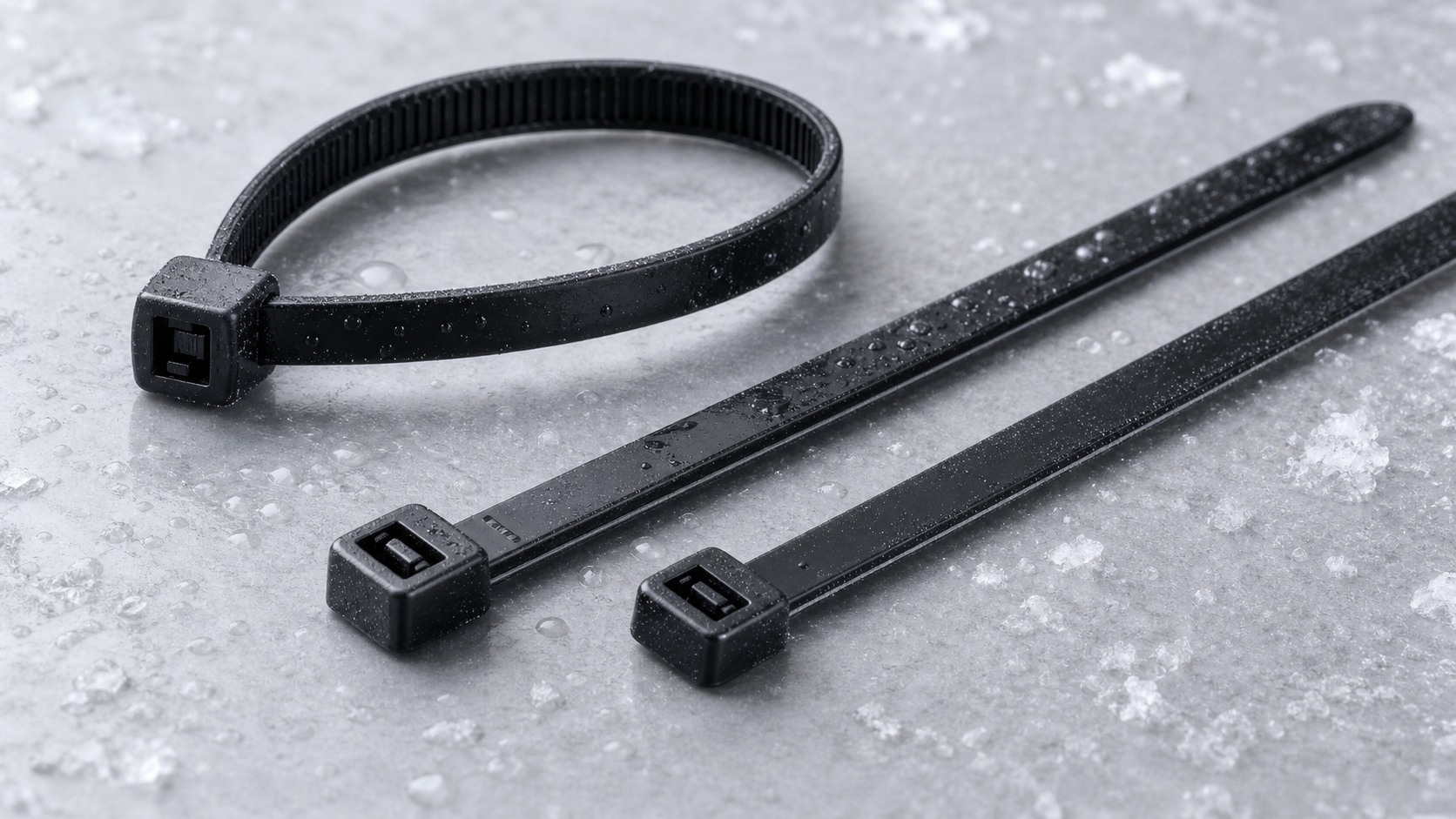
Product detail: square locking head, pass-through mouth, inner teeth and tapered tail must remain structurally accurate.
| Product Type | Key Material | Important Parameters | Typical Cold-Weather Use |
|---|---|---|---|
| Cold-resistant nylon cable tie | Modified PA66 / low-temperature nylon | Length, width, tensile strength, temperature rating, tail flexibility, color | Cold storage wiring, winter service areas and refrigerated equipment routes |
| UV black nylon tie | UV-stabilized PA66 | Outdoor aging, tensile strength, temperature range, bundle diameter, UV resistance | Snowy rooftops, telecom routes, solar support rails and exterior industrial trays |
| Stainless steel tie | SS304 / SS316 | Grade, width, thickness, clasp type, tensile strength, tool compatibility | Severe exposed supports, wet winter routes and long-service fixing points |
| Mounting base | Nylon, stainless or compatible plastic | Screw hole, adhesive suitability, panel compatibility, temperature and moisture resistance | Cold-room wall panels, cabinets, conduit supports and controlled fixing points |
| Installation tool | Manual or tension-and-cut tool | Tension control, cut finish, glove usability, access space | Repeatable tension without over-stressing cold plastic ties |
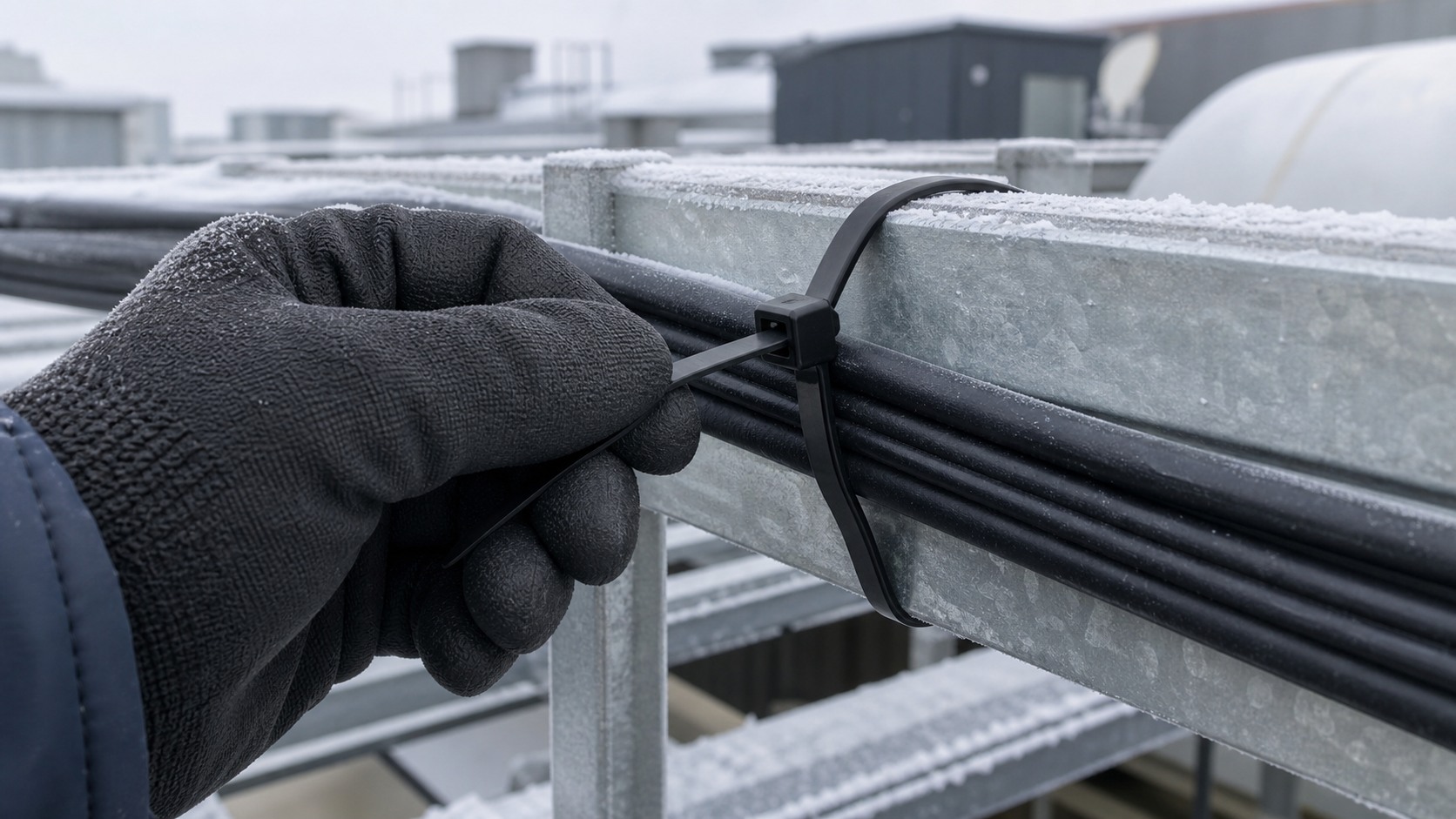
Installation visual: the tail passes through one locking head while the loop wraps the cable bundle and support rail.
Installation Steps
- Confirm the route temperature, installation temperature and whether the tie will see UV, moisture or freeze-thaw cycles.
- Choose cold-resistant nylon, UV black nylon or stainless steel according to the exposure zone.
- Check bundle diameter and the real support point before choosing tie length and width.
- Wrap the tie around both the cable bundle and support where support is needed.
- Pull the tapered tail through the single locking head steadily; avoid sudden jerks that stress cold plastic.
- Apply firm but controlled tension so the cable jacket is not crushed.
- Trim excess tail cleanly and inspect the head, tail exit and loop after installation.
Field Scenario
Application: winter rooftop cable route, refrigerated warehouse equipment and protected cold-room cabinet wiring.
Problem: standard ties became stiff during winter maintenance, causing cracked heads, incomplete tail pull-through and loose cable retention after service.
Solution: CableTiesMFG separated the route into material zones: black UV/cold-resistant nylon for exposed outdoor supports, natural cold-resistant nylon for clean cold rooms and stainless ties for severe exposed points.
Result: the buyer received a clearer material schedule, fewer low-temperature installation failures and more reliable cable retention in winter and cold-storage environments.
Note: page visuals are photo-style application and product visuals for solution explanation, not customer-submitted field photos.
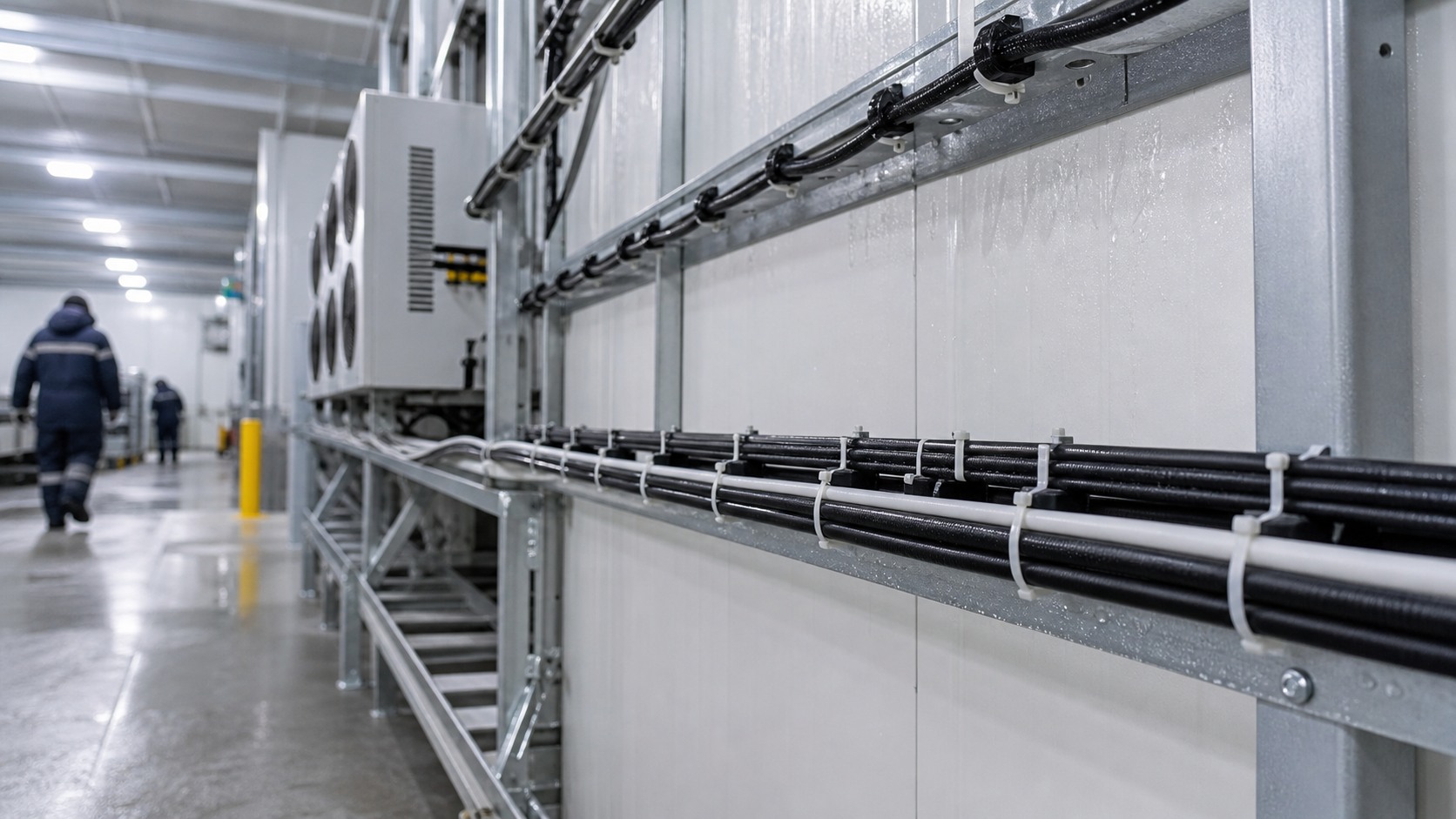
Field scenario visual: cold storage equipment route with repeated cable tie fixing points along insulated wall panels.
Why Choose CableTiesMFG
Environment-Based Selection
We help buyers match low temperature, UV, moisture and mechanical risk instead of choosing by size alone.
Product Geometry Control
We focus on real cable tie structure: flat strap, single locking head, clean tail exit, inner teeth and stable loop retention.
Project Supply Support
Sample packs, material recommendations, private label packaging and bulk export cartons are available for distributors and contractors.
FAQ
Can standard nylon ties be used in cold weather?
Only in controlled or low-risk areas. For outdoor winter or refrigerated sites, use cold-resistant material and test installation at actual temperature.
Is black always better for winter outdoor use?
Black UV-stabilized ties are common outdoors because winter routes may also face sunlight aging. Confirm low-temperature toughness as a separate requirement.
When should stainless steel be selected?
Use stainless where the route has severe exposure, long service intervals, mechanical risk, moisture, corrosion or where plastic tie failure would be costly.
What should be checked after installation?
Check that the loop is complete, the head is not cracked, the tail exits correctly, and the bundle is fixed to the intended support.
Need a Cold Weather Cable Tie Recommendation?
Send your operating temperature, installation temperature, cable diameter, support type, exposure conditions and expected service interval. We will recommend tie material, width, length and mounting accessories for your project.