Environment Solution
Outdoor Cable Tie Solutions for Exposed Cable Routes and Field Installations
Choose UV-resistant nylon ties, mounting bases and severe-duty fixing options for cable routes exposed to sunlight, rain, wind, dust, vibration and daily temperature cycles.
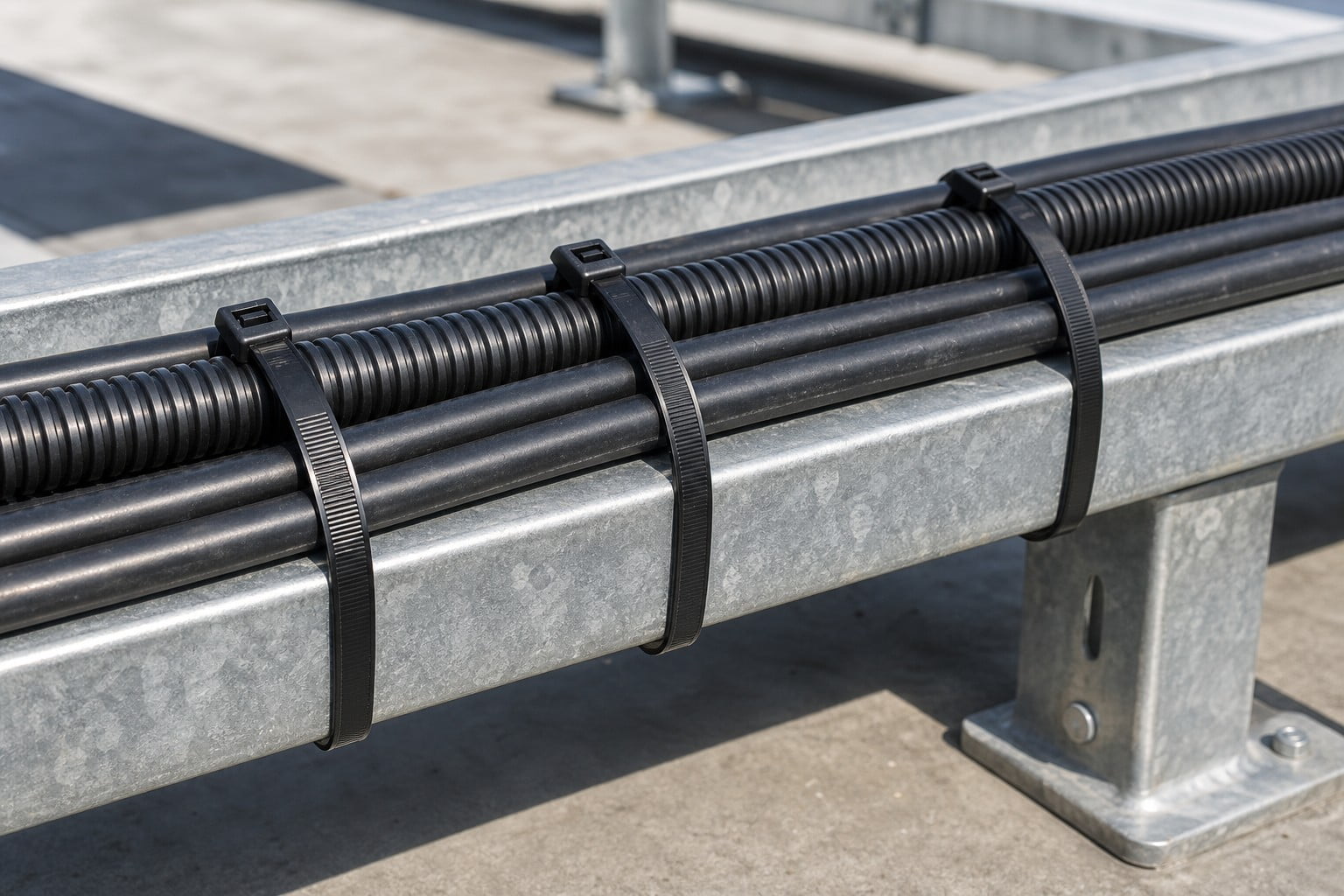
Application visual: outdoor cable routes need ties that wrap the cable bundle and the support point with real contact and tension.
Outdoor Environment Introduction
Outdoor cable ties are used on rooftop equipment, exterior walls, solar frames, utility poles, fences, cable trays, surveillance systems, HVAC supports and field cabinets.
The environment is harsher than indoor wiring: sunlight hardens ordinary plastic, rain carries dirt into the route, wind adds vibration, and cable weight slowly tests every fixing point. A working outdoor solution must match material, tie width, fixing base and installation spacing to the real route.
The key is simple: the tie must physically hold both the cable and its support. If the tie only loops around the cable bundle without anchoring it to a rail, bracket, mount or frame, it may tidy the bundle but it will not control movement.
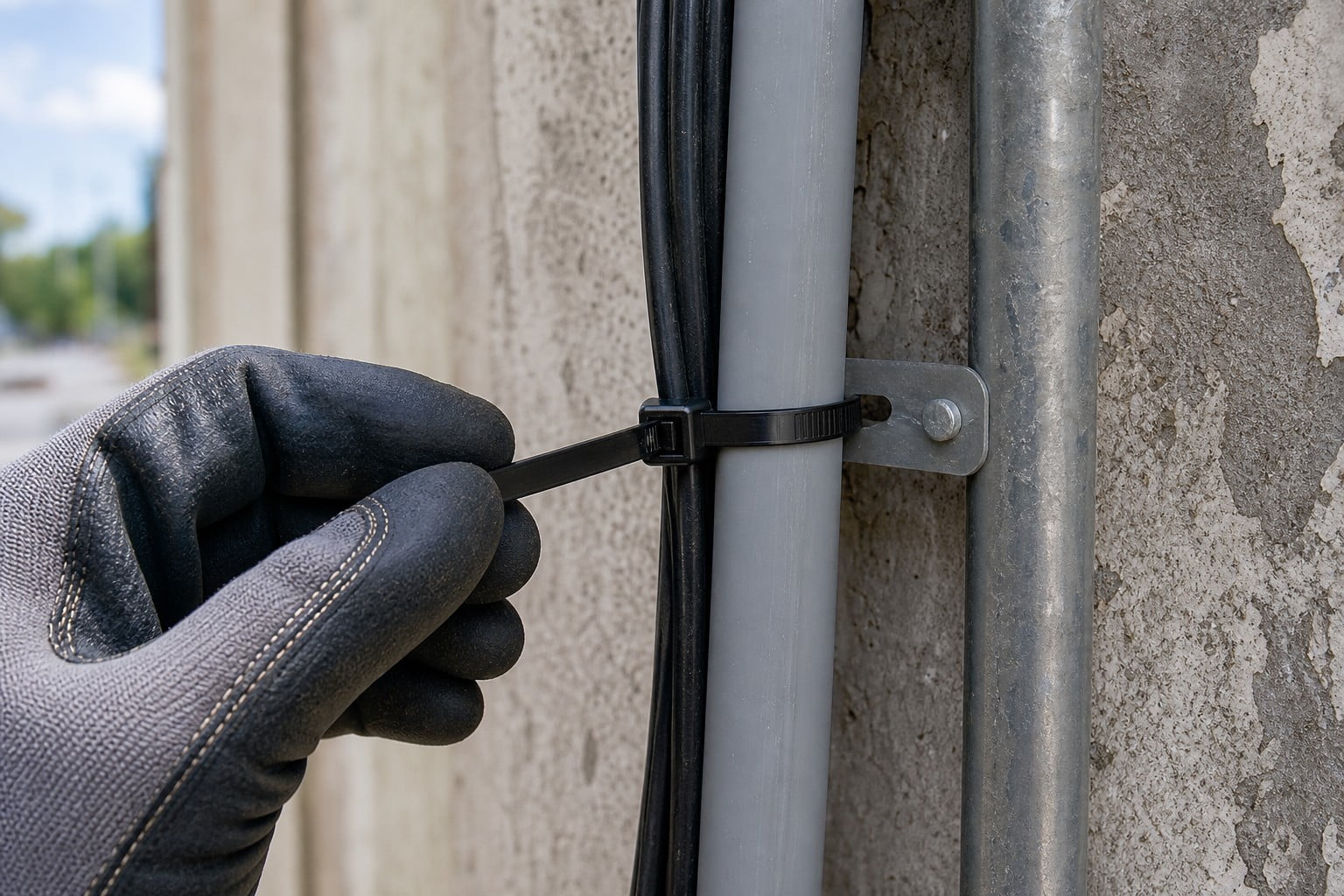
Application visual: outdoor routing often combines cable, conduit, wall brackets and galvanized supports.
Outdoor Pain Points
UV Aging
Standard indoor ties can become brittle, faded or cracked after long sun exposure.
Cable Sagging
Wide spacing or weak ties allow outdoor cable routes to droop, rub and pull against brackets.
Mount Failure
Adhesive-only mounts may fail on dusty, hot, wet or textured outdoor surfaces.
Maintenance Confusion
Mixed materials and inconsistent spacing make route inspection and replacement harder.
Field Problem Analysis
Outdoor cable problems usually begin at the fixing point. A cable can look neat on day one, but if the tie is not UV stabilized, if the support point is too far away, or if the cable is allowed to move in wind, the route gradually loosens.
Look for faded ties, cracked tails, loose loops, cable jacket abrasion, missing support points and tie heads that face sharp edges. These details tell you whether the problem is material, spacing, mounting method or installation tension.
For outdoor routes, product selection and installation method must be judged together. A good UV tie installed at the wrong support point still fails the route.
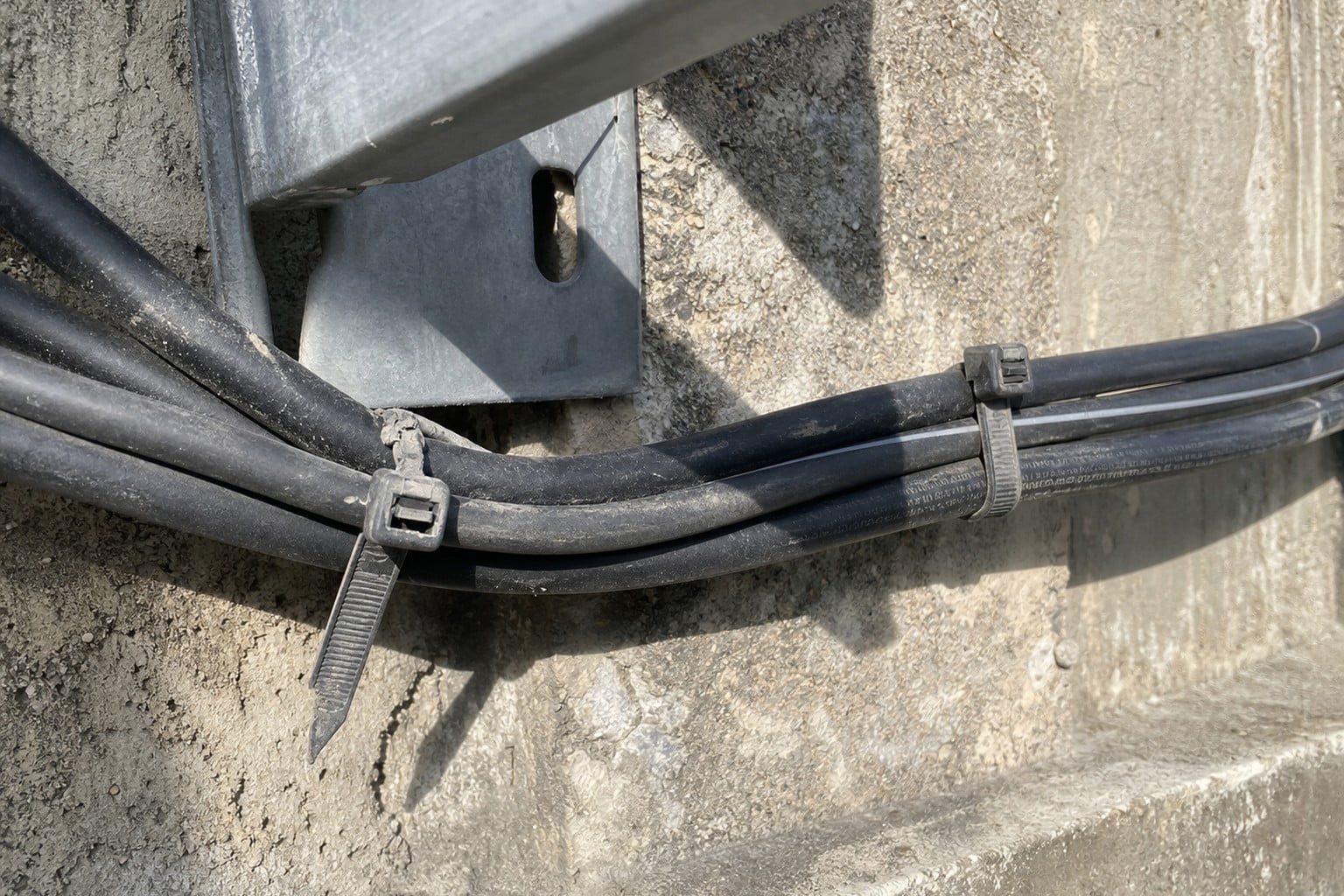
Problem visual: UV aging and loose spacing can let cable routes sag and rub against outdoor supports.
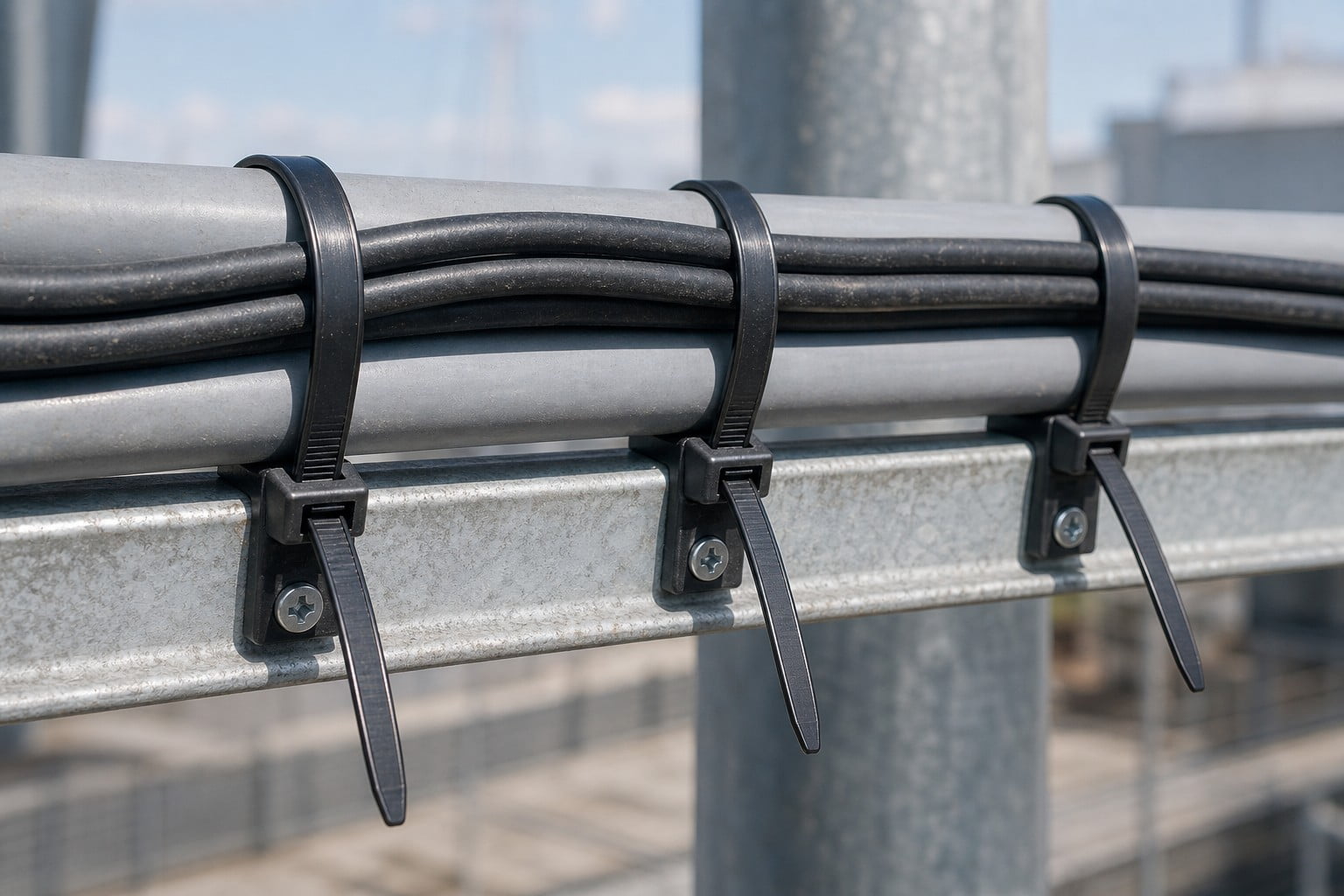
Solution visual: screw-mount bases and UV black ties give the route a defined fixing point.
Recommended Solution
For most outdoor cable routes, start with black UV-resistant PA66 cable ties sized to the bundle diameter and expected load. Use screw-mount bases, saddle mounts or mechanical supports when the cable route needs a fixed anchor on metal, wall, cabinet or frame surfaces.
For coastal, high-heat or severe industrial exposure, add stainless steel cable ties or coated stainless ties in critical retention points. For service areas, use releasable ties where future access is expected, but avoid releasable designs where long-term vibration or tampering risk is high.
Normal Outdoor
UV black PA66 ties for general exposed cable bundles.
Fixed Route
Screw-mount bases for walls, rails, frames and cabinets.
Severe Exposure
Stainless or coated stainless ties for salt, heat and heavy retention.
Product Combination
A practical outdoor cable tie set should cover standard exposed bundling, anchored fixing points, serviceable routes and severe-duty retention.
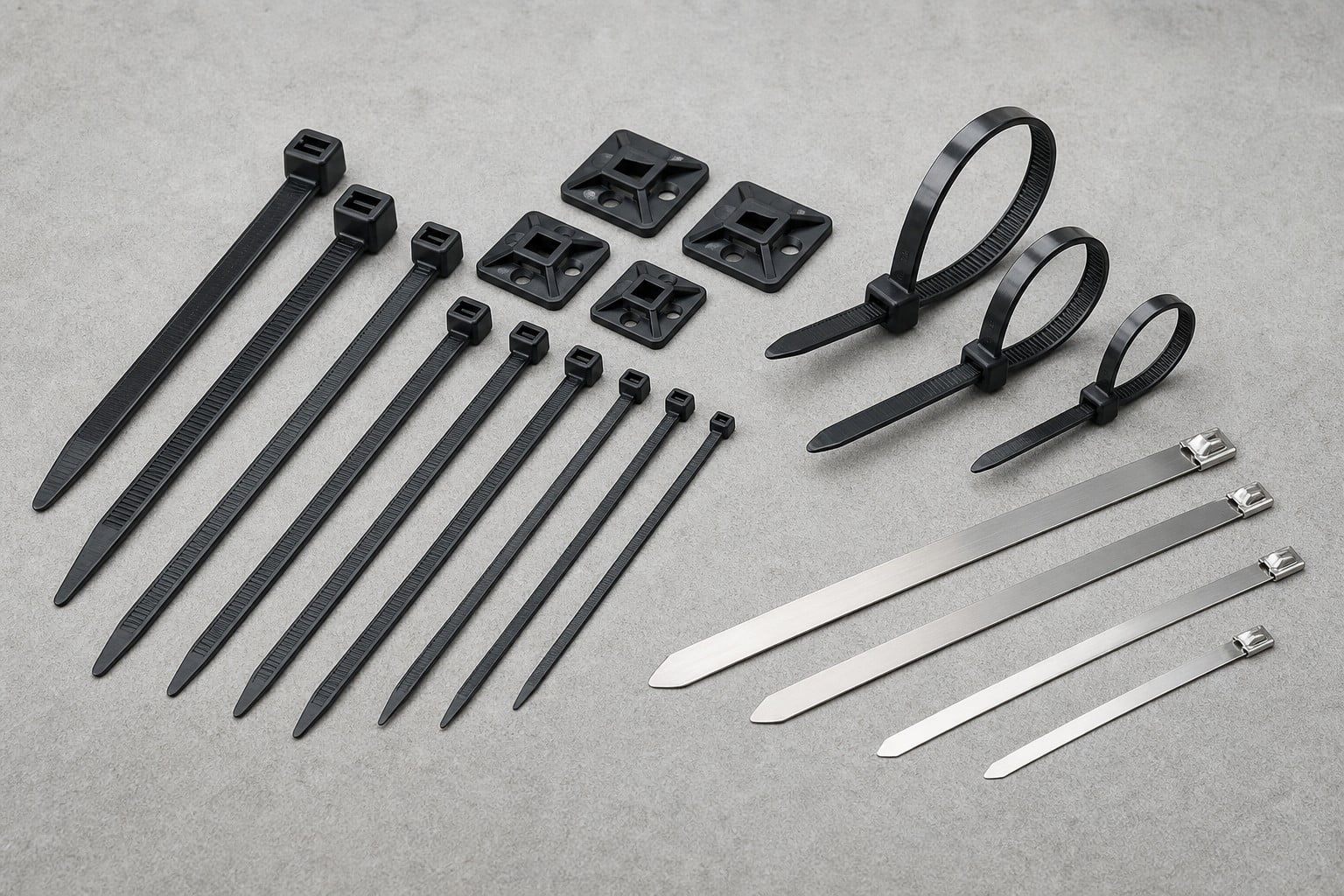
Product visual: UV black nylon ties, screw-mount bases, heavy-duty ties and stainless ties serve different outdoor route risks.
UV Black Nylon Cable Ties
General outdoor bundling, rooftop cable routes, exterior conduit support and field equipment wiring.
Cable Tie Mounting Bases
Used when the cable route must be fixed to a rail, wall, bracket, cabinet or equipment frame.
Heavy-Duty Nylon Ties
Wider tie bodies for larger cable bundles, wind movement and stronger mechanical retention.
Stainless Steel Cable Ties
For salt spray, high temperature, heavy cable support and locations where plastic may not be enough.
Product Parameters
Outdoor cable tie selection is not only about length. Material grade, color, width, tensile strength, mounting method and inspection plan all affect whether the route stays secure after weather exposure.
Use the table below as a starting point for quotation and sampling. For large routes, confirm the cable diameter, support type, exposure zone and required life expectation before finalizing the tie specification.
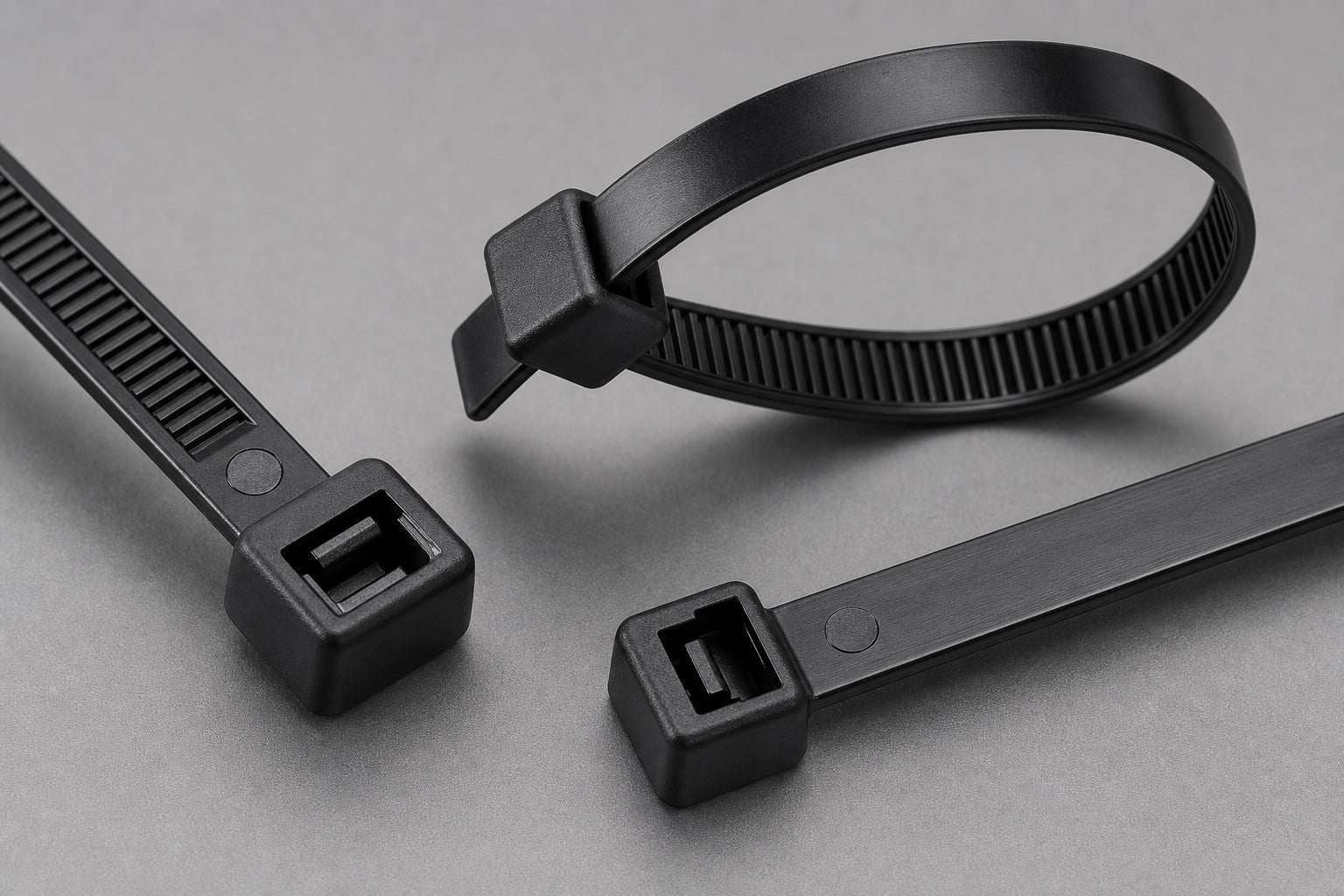
Product detail: outdoor ties still need correct head geometry, inner teeth and a tapered tail, not just black color.
| Item | Typical Specification | Outdoor Selection Note |
|---|---|---|
| Material | UV-resistant PA66, heat-stabilized PA66, SS304 or SS316 | Choose black UV PA66 for sun exposure; choose stainless for severe heat, salt or retention. |
| Color | Black is the default for UV outdoor use | Natural/white nylon is better kept for indoor or protected applications unless specified for outdoor grade. |
| Width | 2.5 mm, 3.6 mm, 4.8 mm, 7.6 mm, 9.0 mm and custom options | Increase width for larger bundles, higher cable weight or stronger wind/vibration exposure. |
| Tensile Strength | Matched to tie width and material grade | Do not use the smallest tie simply because it fits the cable diameter. |
| Mounting Method | Wrap-around, screw-mount base, saddle mount, stainless buckle | Use mechanical mounting for dusty, wet, hot or textured outdoor surfaces. |
| Inspection Interval | Set by exposure severity and site maintenance plan | Inspect for cracking, looseness, abrasion, broken tails and support movement. |
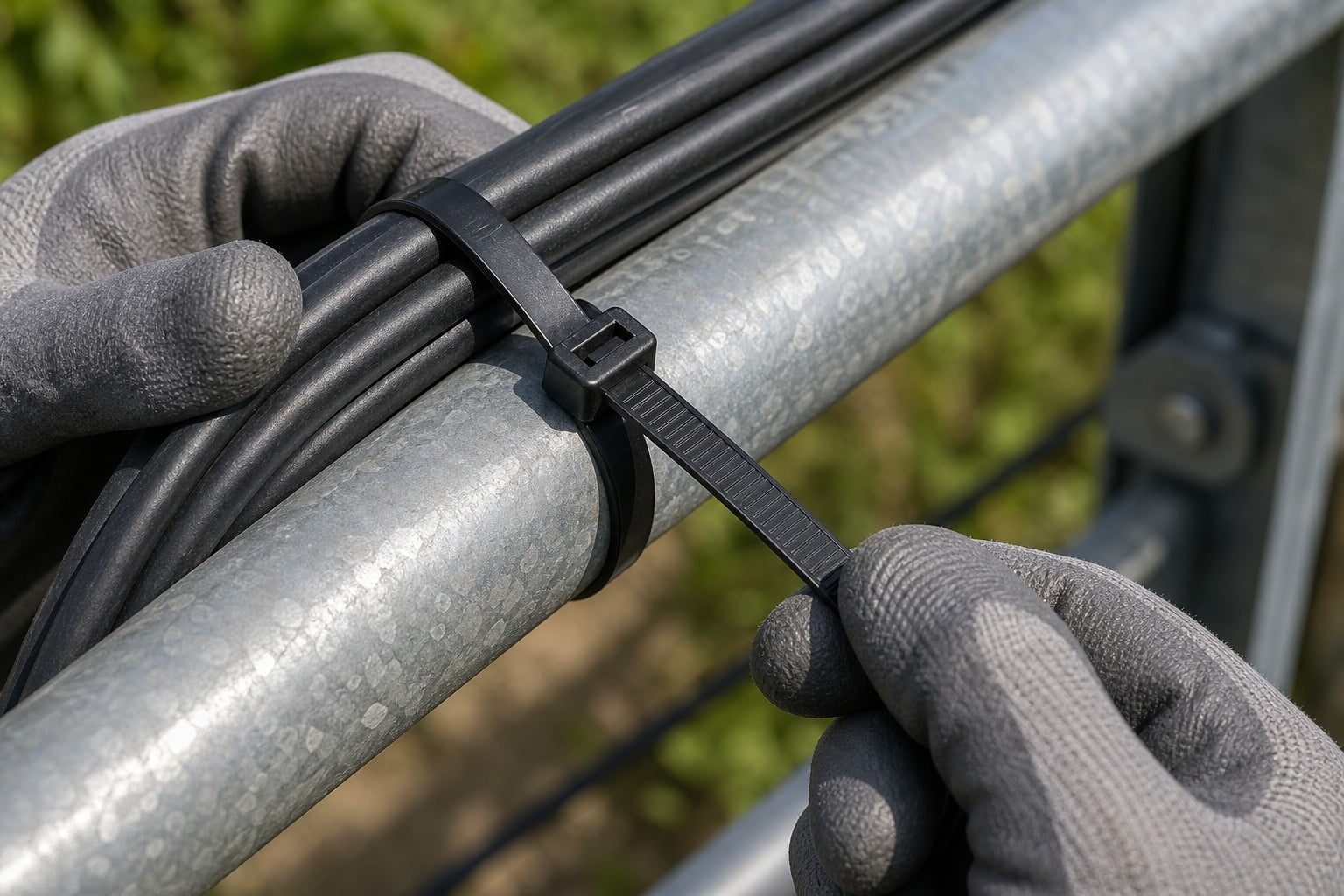
Installation visual: the tail must pass through the locking head and the tie must restrain the cable against its support.
Installation Steps
- Check the route exposure: sunlight, rain, wind, salt, heat, vibration and inspection access.
- Select UV black PA66, heat-stabilized nylon, stainless steel or coated stainless steel according to the exposure level.
- Confirm that every fixing point holds the cable against a real support such as a rail, bracket, mount base, cabinet or frame.
- Route the cable before tightening ties; avoid using cable ties to force an unnatural bend.
- Wrap the tie around the cable and support, then pass the tail through the square locking head.
- Apply controlled tension so the cable is secure without cutting into the jacket.
- Trim the tail cleanly and orient the locking head away from sharp edges, walkways and maintenance access points.
- Inspect exposed routes on a maintenance schedule and replace brittle, loose or cracked ties before the route fails.
Field Case
Application: rooftop equipment cable route with exposed black power and control cables on galvanized supports.
Problem: mixed indoor ties and inconsistent spacing created loose sections, cable sag and harder maintenance checks after outdoor exposure.
Solution: CableTiesMFG recommended black UV-resistant PA66 ties for general exposed routes, screw-mount bases at defined support points, and stainless options for severe-duty zones.
Result: the route gained clearer spacing, better retention and easier visual inspection during maintenance.
Note: page visuals are photo-style application and product visuals for solution explanation, not customer-submitted field photos.
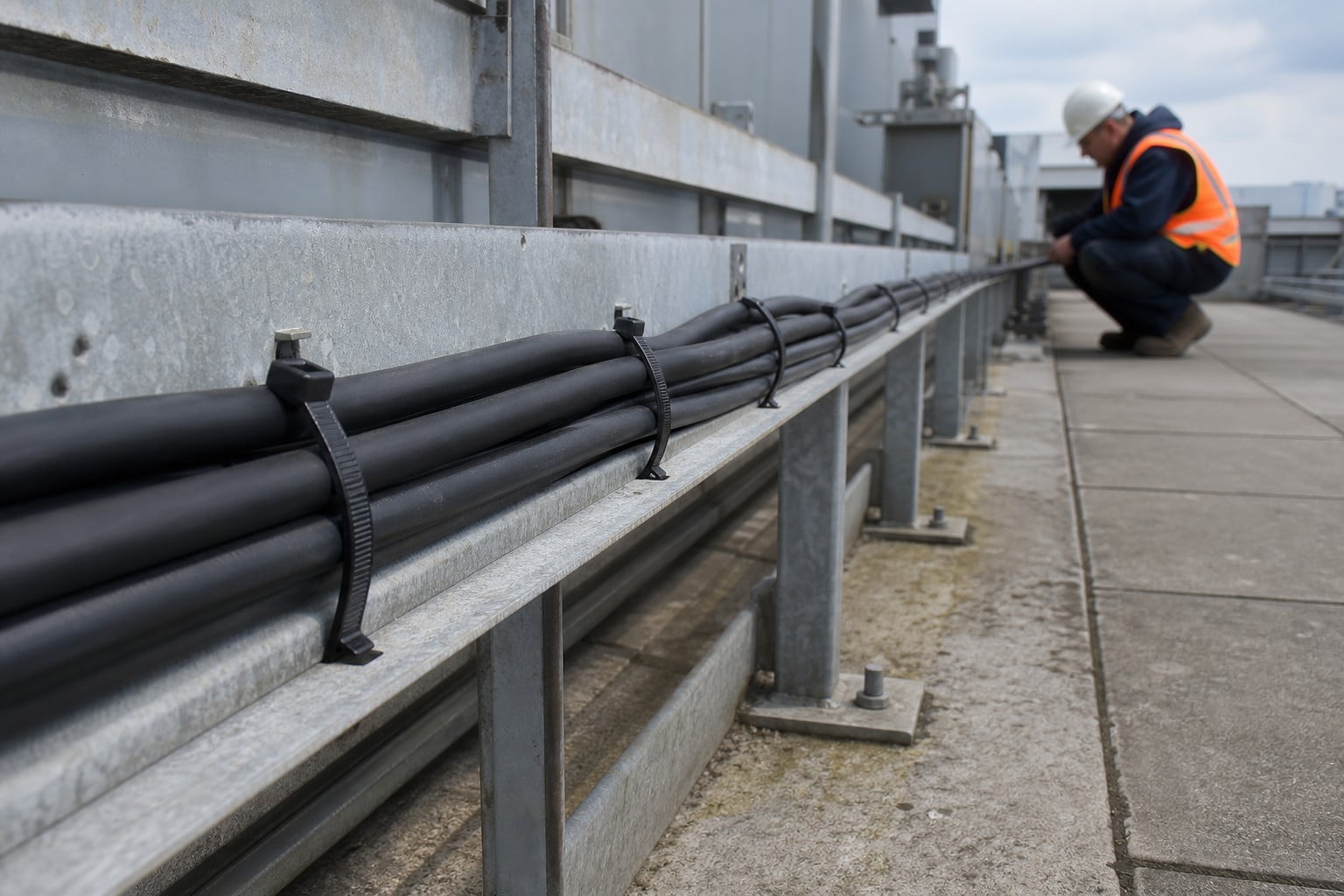
Field visual: consistent spacing and visible fixing points make outdoor routes easier to inspect.
Why Choose CableTiesMFG
Outdoor Material Selection
We help buyers separate UV-resistant nylon, heat-stabilized nylon, stainless steel and coated stainless options by route exposure.
Application-Based Quotation
Send cable diameter, support type, exposure level and quantity. We can recommend the starting tie width, material and mount type.
Bulk Supply Support
Factory supply, private label packing, sample kits and project quantity support are available for distributors, contractors and OEM buyers.
FAQ
Are black cable ties always UV resistant?
No. Black color alone is not enough. Ask for UV-resistant material grade and suitable outdoor aging performance for your application.
Can adhesive cable tie mounts be used outdoors?
Only in limited, clean and protected conditions. For dusty, wet, hot or textured surfaces, screw-mount bases are usually more reliable.
When should stainless steel ties be used outdoors?
Use stainless ties for salt spray, high temperature, heavy retention, severe vibration or locations where nylon aging risk is not acceptable.
How tight should an outdoor cable tie be?
Tight enough to prevent movement, but not so tight that it cuts the cable jacket. Use controlled tension and inspect for compression marks.
Related Product and Technical Links
Stainless Steel Cable TiesMetal cable ties for severe outdoor, high temperature and corrosion-prone routes.
UV ResistantMaterial guidance for sun-exposed outdoor cable management.
Corrosion ResistantUse for salt spray, chemical washdown and wet outdoor exposure.
Need an outdoor cable tie recommendation?
Send your cable diameter, support type, exposure level, required material grade and project quantity. We can recommend UV nylon, mounting bases, heavy-duty ties or stainless options for your outdoor route.